Preventive action to minimize the effects of the COVID-19 pandemic in Senegal, Honduras, and Nepal.
The current crisis caused by the arrival of COVID-19 in Europe has led to the mobilisation of organisations working in humanitarian aid to assist the most vulnerable people around the world.
At Acció Solidària i Logística, we are also committed to this cause. As an organisation working on development cooperation and emergency projects around the world, we believe that at a time like this it is important to call for ‘global solidarity’, because this crisis affects us all. The consequences of this crisis will be devastating for many people, not only from a health perspective, but also socially and economically.
The pandemic has already reached more than 200 countries around the world, many of which do not have the structures or minimum conditions to deal with a pandemic of this type and where the consequences (health, social and economic) are expected to be very serious.
A.S.L. is launching a campaign to raise funds and take action in three of the countries where we are currently carrying out development cooperation projects: Senegal, Honduras and Nepal.
Our action aims to help minimize the effects of the arrival of this pandemic in these countries by ensuring the disinfection of spaces, providing preventive information to the population and facilitating their confinement by supplying food and other basic necessities.

Senegal:
In Senegal, a large part of the population lives below the poverty line, and the country does not have adequate health structures to deal with a pandemic of this type.
Senegal has a poverty rate of 52.3%. In terms of health conditions, 147 women and 219 men per 1,000 inhabitants die in the country. In addition, the country has other deadly diseases, such as malaria (almost 65 people per 1,000 die from this disease) and tuberculosis (with 122 people affected per 1,000 inhabitants).
Medina Boudialabou is a rural village of 860 inhabitants, most of whom live from agriculture and fishing. However, in order to purchase most of their food and basic necessities, as well as to obtain energy supplies, the population is forced to travel regularly to the nearest town, Ziguinchor, which is 14 km away.
The families in the village do not have a sufficient water supply and therefore do not have the minimum conditions necessary to maintain good hygiene and reduce the risk of infection.
Actions:
Since mid-April, ASL has been working in different phases.
The first shipment of funds was used to purchase equipment to control the three access points to the village and to disinfect people and vehicles returning from the city.
Awareness-raising and training activities have been carried out among the population.
Disinfection of houses and the village in general.
Purchase and distribution of food to all inhabitants to encourage the reduction of population movements, helping to comply with the lockdown order decreed by the government. (1,700 kg of rice).
After one month of working at the local level, and although there are more cases of COVID-19 every day in Senegal, the disease has not entered Medina.
We continued our pandemic prevention work during May, June and July, maintaining our efforts to raise awareness, train and inform the population about the activities being carried out.
Operational maintenance of disinfection equipment (3 entry points to the village, 1 entry point to the gardens and 1 mobile unit), monitoring of entry checkpoints and the use of disinfection materials.
Door-to-door awareness-raising and information campaign on COVID-19 in the 56 houses in Medina, carried out by the mobile team.
Purchase of 1,500 kg of rice (34 50 kg sacks) and distribution of 25 kg to each family in the village, this being the second food distribution to the population.
The government is reopening schools on 2 June, which means that pupils and teachers will start travelling to educational establishments. For this reason, ASL is distributing 100 additional face masks to pupils in the village (from the primary school and secondary school in the neighboring village of Djibonker) to improve safety conditions.
We are buying more bleach and liquid soap to reinforce the checkpoints.
Total disinfection of the Medina primary school before reopening the center.
On 5 July 2020, the Senegalese Ministry of Health reported 7,400 cumulative cases of COVID-19 and a total of 133 deaths in the country.
Raising awareness among the population, purchasing disinfection materials and products, together with the food aid that has been provided on two occasions, have been key to ensuring a reduction in the mobility of people who travel regularly to the city and to controlling the pandemic.
The involvement of the population of Medina on the one hand, together with the continuous help of ASL on the other, have yielded good results. Since the arrival of the pandemic in Senegal, Medina Boudialabou has had zero cases of the disease.
Since the end of July, our representative in the country has been working in the area after returning from lockdown, and we are trying to resume the activities planned in the town as part of the cooperation projects we are developing.
In September, we continued to help protect Medina against COVID-19 by purchasing the following materials for distribution among the population:
1.5 tonnes of rice (30 50kg sacks per family), bottles of liquid soap and bleach (2 boxes of each) and 100 face masks.
A general awareness session was also held to remind people that the disease is still present in the country and that protective measures must continue to be maintained.
ASL has funds available in Senegal to enable it to act quickly on any task related to the pandemic, both for new actions and for replenishing stocks of preventive materials.

Disinfectant materials.

Entry point to the town.

Food distribution.

Distribution of face masks to schoolchildren.
HONDURAS:
Honduras has a poverty rate of 19.3% and a malnutrition rate of 177 and 170 men/women per 1,000 inhabitants. Other diseases are also present, such as tuberculosis, which affects a total of 38 people per 1,000. The country does not have adequate health structures to deal with a pandemic of this type.
During the month of May, 1,685 cases were detected and a total of 105 people died from the virus.
The Honduran government has decreed a lockdown for the population. In the towns where ASL works, the vast majority of people are engaged in informal trade and transport, while many others depend directly on remittances from their emigrated relatives (many of whom have stopped receiving them as a result of the emergency).
A large part of the country’s economy is based on this informal trade, and people who sell on the street (71% of the economy comes from these traders) are suffering a loss for many families due to the ban on leaving home.
For this reason, it is difficult for the population to comply with the authorities’ lockdown recommendations and stay at home, as they do not have the food they need to survive or the money to buy it.
El govern hondureny realitza repartiments d’aliments a les famílies que consideren més necessitades però, no obstant això, en un país amb gairebé 8 milions d’habitants, aquesta mesura no arriba a tothom i resulta insuficient.
ASL vol intentar garantir un millor confinament de la població, evitant els desplaçaments i assegurant l’arribada dels productes de primera necessitat a famílies del municipi de La Masica, on ASL hi treballa en diferents projectes de cooperació al desenvolupament.
Al país la ONG sempre ha col·laborat amb els bombers i alguns dispensaris locals. Aquests col·lectius estan en primera línia en l’assistència a la població davant l’emergència. La idea és ajudar-los amb materials de prevenció dels que no disposen en la quantitat que necessiten.
Actuacions:
A finals de maig, ASL adquireix menjar i productes d’higiene personal per elaborar bosses solidàries que es reparteixen a les 200 famílies de l’aldea de La Masica. El repartiment d’aquests productes és imprescindible degut a les condicions d’aïllament físic d’aquesta població i on els aliments governamentals no hi han arribat.
La bossa solidària consta d’arròs, llegum, farina, pasta, salses, sal, sucre, mantega, condiments, cafè, avena, sopa, sabó per a roba i vaixella, clor i desinfectant. Calculat per a que les famílies puguin aguantar durant un mes.
Durant el mes de juliol s’adquireix i es reparteix materials de prevenció als bombers de San Pedro Sula, Potrerillos, Villanueva i el Centre de Salut de Monterrey. Entitats amb les que ASL sempre ha col·laborat i que mantenen equips d’intervenció en primera línia d’assistència a la població.
El repartiment consisteix en desinfectant, alcohol antisèptic, mascaretes de protecció i quirúrgiques, guants i bates.

Preparant les bosses solidàries.

Repartiment de les bosses.

Donació al centre de salut.

Donació als bombers de San Pedro Sula.
NEPAL:
A finals del mes de gener de 2020 va aparèixer el primer cas a Nepal, semblava inevitable un imminent contagi de tota la població, agreujat pel precari sistema de salut i els pocs recursos per lluitar contra l’epidèmia. Res mes lluny de la realitat ja que la situació es va contenir moderadament. Al país, el segon cas de contagi no va arribar fins la tercera setmana de març, quan es va declarar el confinament. La situació d’alarma a tot el mon, només fa presagiar lo pitjor pel Nepal, un dels països mes pobres del mon.
El 24 de març, seguint l’exemple de l’Índia, Nepal declara el tancament total de fronteres, aeroports i tots els negocis, amb només dos casos declarats de Covid-19. Provocant lo que finalment serà una situació insostenible, escassetat d’aliments i ensorrament total de l’economia de subsistència de milions de famílies.
La situació tampoc es econòmicament bona als països d’acollida dels emigrants nepalesos, dels que en depèn l’economia del país, tenint en conte que la primera font d’ingressos es l’enviament de diners dels milions de nepalesos que treballen a l’estranger. Al ser una crisis mundial, molts d’ells es queden sense feina i forçats a tornar a casa des de països amb alts índex de contagi. Això acaba per provocar que el virus es propagui al Nepal.
El principal problema del Nepal a dia d’avui, no ha estat el Covid-19, si no les conseqüències derivades de la seva prevenció. Els casos continuen augmentant considerablement cada dia. Però, l’índex de letalitat es insignificant en proporció a la població. Es molt probable que mori mes gent de fam o altres raons vinculades al confinament, que del propi virus.
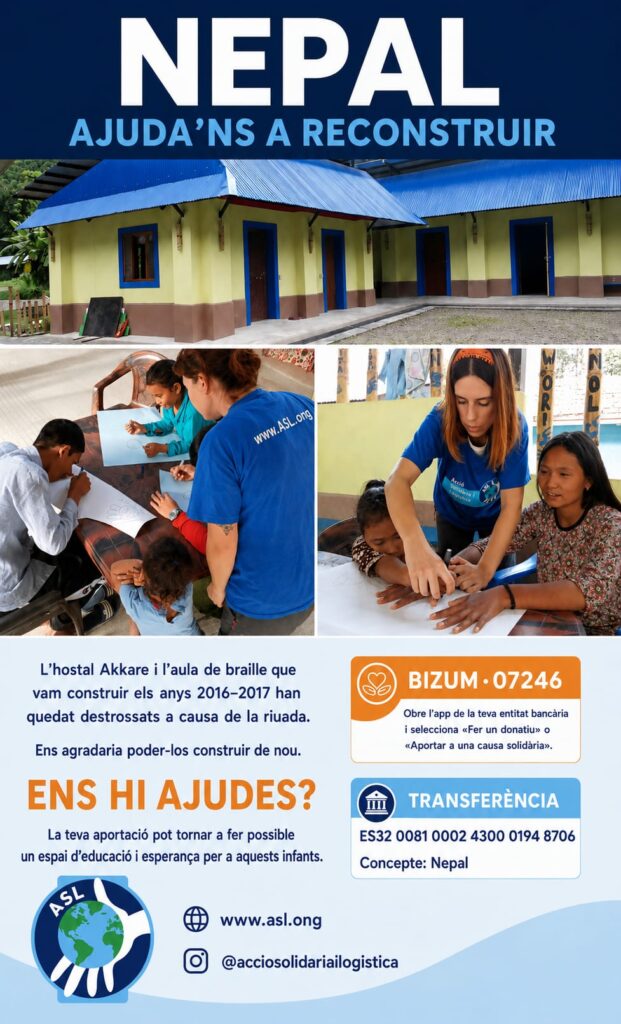
ASL va començar a treballar al Nepal durant el terratrèmol de 2015, realitzant diferents tasques d’ajut d’emergència i prosseguint després en projectes de cooperació al desenvolupament en diverses àrees i àmbits. En aquests temps de treball, coneixem entre d’altres organitzacions, a Hugging Nepal. És tracta d’una ONG amb seu a Palma de Mallorca i que conta amb molts voluntaris espanyols i internacionals, que durant aquesta crisi i tancament de fronteres, s’han dedicat a adquirir, cuinar i repartir aliments, porta a porta i en llocs comunitaris, a les persones més necessitades de la capital i nucli de població més gran del país, Kathmandu.
La confiança en la gran tasca d’aquests voluntaris confinats a Nepal, i el repartiment dels aliments a nuclis de població on ASL esta treballant en cooperació, ens porta a col·laborar, en la mida del possible, en aquest projecte.
Actuacions:
A mitjans de juliol, ASL realitza un enviament de fons econòmics que permet l’adquisició i repartiment d’aliments durant alguns dies en les zones de treball de la ONG.
A finals d’octubre vam rebre la notícia del suport econòmic per part de l’ajuntament de Sant Feliu. El dia 29 del mateix mes, vam fer una aportació que va repercutir en el subministrament de 1.145 kg d’arròs entre d’altres aliments, resultant en una ajuda alimentària a 265 persones i aproximadament 70 famílies.
A mitjans de desembre, vam enviar una donació econòmica als nostres companys de Huggings Nepal, coincidint amb la inauguració d’un menjador social. Aquesta instal·lació és necessària a causa dels impediments de les autoritats locals a realitzar aquest repartiment casa a casa i al carrer. Des del menjador es pot controlar més les quantitats i l’aprofitament dels aliments. ASL pretén col·laborar amb el manteniment d’aquest projecte tan imprescindible en temps de pandèmia al Nepal.
El nostre suport es quantifica, aproximadament, en 1.100 kg d’arròs i 600 kg d’altres aliments per cuinar al menjador social.

Nens en la cua del repartiment.

Repartiment de menjar cuinat.

Local del menjador social